
1950 Royal Desserts
The 1950 Royal Desserts Stars of Basketball set contains 8 cards that are hand-cut from the backs of packages of Royal Puddings, Royal Gelatin Desserts, Royal Tapioca Puddings and Royal Custard Flavor Dessert Mix. Cards were also produced for baseball, hockey, movie stars, Howdy Doody, Alice in Wonderland, and Stars of the Sky (airplanes).
The cards are numbered from 1 to 8, measure roughly 2 5/8" by 3 1/4" and have blank backs. The card fronts have a red header at the top and are divided into halves below. The left half has a grayscale head shot of the player and a facsimile autograph, while the right half has a biography. An 8-page “Plastic Album” was available for those who sent 15¢ plus 3 Royal Dessert package fronts. The set is classified in the American Card Catalog by Burdick as F219-2.
The Royal Desserts cards came in two versions - black text and image, and blue text and image. Cards with blue lettering are much rarer than the black ones. The blue ink version released exclusively on the Custard Flavor Dessert mix boxes, while "the more common black version of these cards were released on all other boxes. The Custard Flavor Dessert mix boxes were manufactured in smaller quantities compared to the other flavors (Lemon, Chocolate, etc.) accounting for the rarity of blue ink cards.
PSA does not note the differentiate between black and a blue ink cards. They all get slabbed under the same label and pop count. SGC does separate the two and, as of 9/1/26, shows 3 blue ink cards in its pop count.
Regardless of ink color, Royal Desserts basketball cards are super rare as shown by PSA's low pop counts. As of 9/1/26, there are only a total of 47 graded by PSA and 57 graded by SGC. Further, a case that was sold at Heritage Auctions shows that player boxes were made in different quantities resulting in short prints like Schaus.

Why Does This Set Consist Of Mostly Low Graded Cards?
As of 9/1/26, the highest grade PSA grade is 7.5 (Fulks) and SGC grade is 5.5 (Schaus). Most have much lower grades with 32% and 37% of the pop counts being PSA and SGC Authentic. Why is grading for these cards so tough?
Hand cutting a roughly 2 5/8" by 3 1/4" card from a 3" x 3 ½" bottom panel (some boxes were even smaller) is no easy feat. These dimensions leave only a total excess of 1/4" on the box length and 3/8" on the box height. To make an equidistant cut on both sides, there is a tight margin of 1/8" on each side and 3/16" on the top and bottom.
Further, the cards were often poorly cut reflecting the excitement of a youngster clipping away with uneven edges, jagged corners and skimpy (or no) borders. Cutting a card out of an intact box creates severe physical interference because the 1-inch side panels restrict scissor movement, visibility, and leverage. The kids certainly weren't thinking of grading companies' rigorous standards that would come into play many decades later.
Adding to the above challenges, some boxes were made in smaller sizes and others included a red stripe further reducing the cut area. See photo to the left.

The best card in this set is the #6 George Mikan. This photo depicts one of the two PSA 4s, the highest grade given by PSA for a Mikan (to date)

The 1950 Royal Desserts have. blank backs.
Un-Opened Royal Desserts Boxes

Un-Opened Royal Custard Flavor Dessert Mix with rare blue ink Mikan.

Un-opened Chocolate Flavor Pudding with black ink Mikan.

Royal Desserts ALBUM

Collectors could obtain an album to hold the 8-card set by mailing 15 cents and 3 package fronts

Inside of Royal Stars album.

Inside of Royal Stars album (aerial view)
PSA Incorrectly Catalogues This Set As 1952
The Royal Desserts Set Was First Released In 1950
The 8-card Royal Desserts basketball set has traditionally been cataloged as from 1952. However, overwhelming evidence Including an ad in Superman #69, points to late 1950 as its true issue date. Specifically, the players’ ages, team affiliations, and career statistics printed on the cards are all consistent with a 1950 release year. Nevertheless, PSA and SGC continue to erroneously list these cards as from 1952.
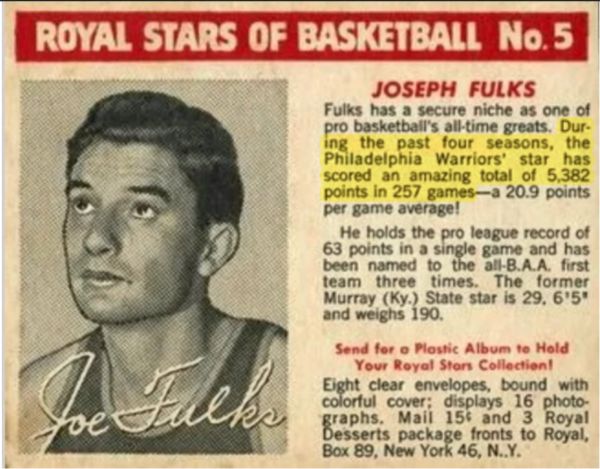
The most obvious clue that this set was released well before 1952 can be found in the text of the cards themselves. Six of the eight Royal Desserts cards Mikan, Pollard, McGuire, Schaus, Nichols and Brian - contain statistics from the 1949–50 season, with none citing statistics from the subsequent 1950–51 season. That consistent pattern strongly supports the cards having been prepared and first released in mid- to late-1950. Similarly, the Joe Fulks card uses 1949–50 as its statistical endpoint. It credits Fulks with 5,382 points in 257 games over the “past four seasons,” totals that precisely correspond to his career through the end of the 1949–50 season. Thus, if the set were first created in 1952, Royal inexplicably ignored an entire completed NBA season in 7 of its 8 cards.

The sole card that omits statistics is that of Buddy Jeannette. However, it provides the strongest evidence of a 1950 release year. Jeannette’s card states that he “is retiring from play” to concentrate on coaching and managing the Baltimore Bullets. Jeannette’s playing career ended after the 1949–50 season, and Baltimore placed his player contract on waivers on July 1, 1950, strongly supporting a 1950 release. Moreover, Jeannette was fired as Baltimore’s coach and ceased serving in the general manager role on January 18, 1951, meaning the card’s description of him was already outdated after that date and strongly indicates that the set was first released no later than January 18, 1951.
Further, 5 cards contain player ages that fit late 1950 as a release date. Schaus is listed as 25, McGuire as 24, Nichols as 24, Fulks as 29, and Mikan as 26, ages that are all simultaneously correct only from October 26, 1950 through January 24, 1951. That overlap is remarkably consistent with the cards’ statistics, which stop after the completed 1949–50 season. The one notable exception is Jim Pollard, whose stated age appears to be off by a year, but his card also contains another biographical error (he was from Oakland CA, not Minneapolis, MN), making that single discrepancy far less significant than the otherwise consistent age pattern across the five other cards with ages.
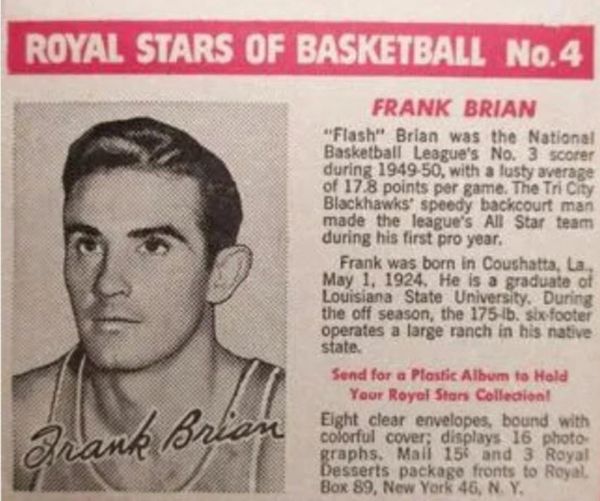
Frank Brian’s card provides especially strong dating evidence because it uses his 1949–50 Anderson scoring statistics while identifying him as a Tri-Cities Blackhawk, the team he joined in May 1950, exactly the combination one would expect from a bio written during the 1950 offseason or early in the 1950–51 season. Brian and Nichols are both identified with the Tri-Cities Blackhawks, a franchise name that disappeared after the 1950–51 season. Brian himself had also left Tri-Cities for Fort Wayne by mid-1951.
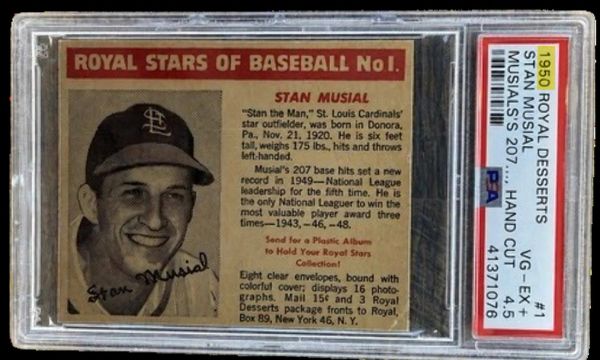
PSA’s treatment of Royal’s baseball cards further supports re-cataloguing the basketball set. PSA already identifies Royal’s hand-cut baseball package-back cards as a 1950 issue. See the Stan Musial card labeled by PSA as 1950.
The separate “1952 Royal Desserts” baseball set is actually a different 16-card premium issue consisting of 5" × 7" photographs with facsimile autographs. The basketball cards, like the 1950 baseball cards, were hand-cut directly from Royal dessert boxes and contained player photographs and biographies. It is, therefore, difficult to explain why PSA dates the baseball package-back issue to 1950 while continuing to label the corresponding basketball issue 1952..
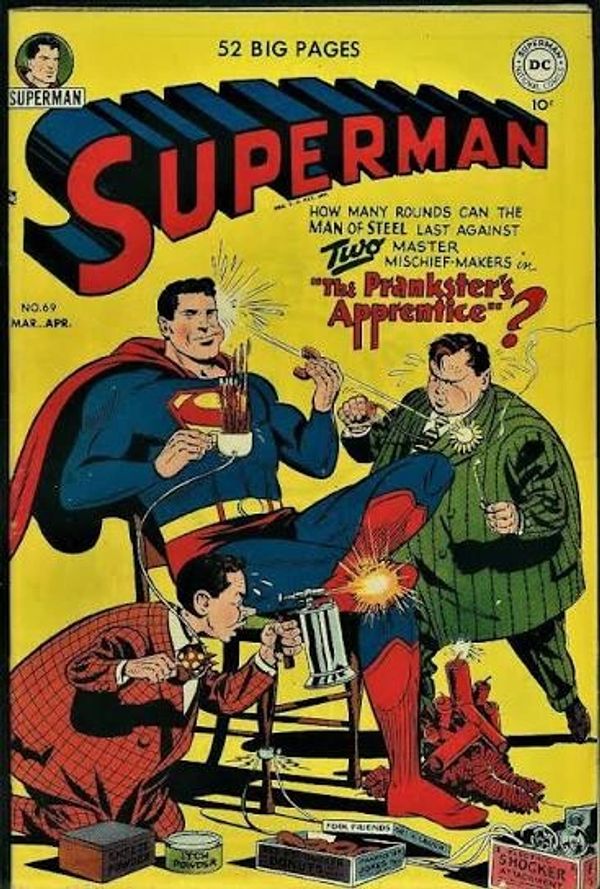
If there were any doubt about whether Royal’s basketball-card promotion was in circulation during 1950, it is removed by an advertisement placed by Royal Desserts in DC Comics' Superman #69.
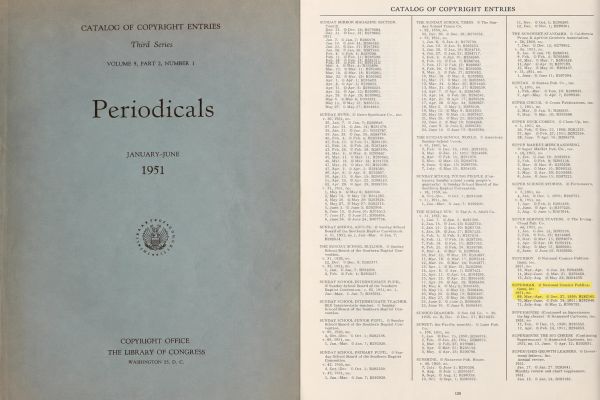
Superman #69 went on sale on December 27, 1950, as documented from its copyright registration. This issue contained a full-page Royal Desserts advertisement that actually pictures George Mikan as one of the Royal sports stars available on its package backs. Further the ad states: The ad expressly tells readers that the Royal Desserts cards feature, among other things, "America’s most famous players in hockey and basketball" (emphasis added). Scroll down to see ad.
On that same date, Leave It to Binky #19 also went on sale with a Royal advertisement specifically indexed as “Collect Royal Stars of Sports and Movies Free of Extra Cost!” Thus, Royal was not merely preparing the basketball cards in 1950, it was publicly advertising their availability in multiple publications before the end of that year.
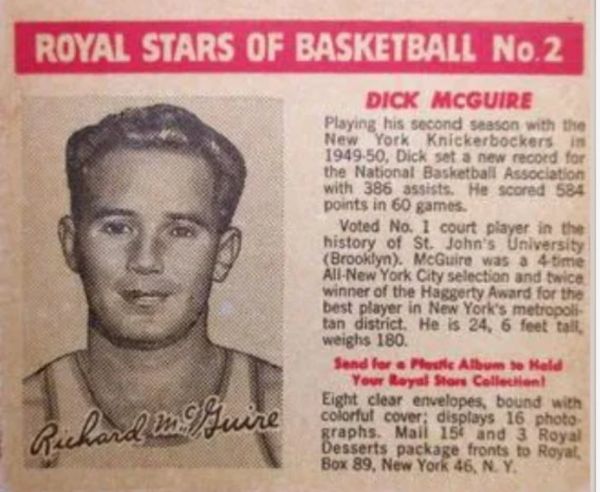
The card that is the biggest winner with this re-cataloguing is that of Hall of Fame player McGuire. His Royal Desserts card should be considered his first card, released one year before his 1951 Bread For Energy card. The Schaus card is now a co-first card (tied with his 1950 Bread For Health card). This is significant because both of the McGuire and Schaus cards have extremely low pops. As of 9/1/26, the PSA pop report for Royal Desserts McGuire is a total of 9 and for Schaus it is only 4, the latter being the lowest pop, by far, in the whole set. Because Mikan, Pollard, Jeannette and Fulks are all part of the 1948 Bowman set (among others), their Royal Desserts cards should be considered second-year cards. The Nichols and Brian cards remain their first cards.
In sum, Royal most likely continued using the same packaging after its initial release through 1952 but continued distribution is not the same thing as the year the cards were first issued. Therefore, grading companies should re-catalogue this set as 1950 to accurately reflect its true year of release.
Royal Desserts AdvertisementS

This Royal Desserts ad first appeared in the December 27, 1950 issue of Superman #69.

Comic book ad for Royal Desserts including Jim Pollard and Dick McGuire images.